Reverse mentoring: How senior and junior IT professionals grow together
Remote work, despite bringing many benefits in terms of flexibility, has proven to be an obstacle to the exchange of experiences between juniors and seniors, especially when it comes to informal learning and intergenerational mentoring.
When there is no physical presence in the office, we lose corridor conversations, spontaneous moments of observation, and shadowing – all crucial for the development of younger professionals through proximity to more experienced colleagues.
For example, according to an article in the Financial Times, the hybrid or fully remote model “prevents young people from learning alongside senior professionals,” making it difficult to replicate the traditional “learning by proximity” (apprenticeship) model.
Reverse mentoring emerges as a differentiating practice in which junior professionals also help seniors grow, creating a two-way learning relationship.
In the Information Technology (IT) sector, learning never happens in just one direction. If traditionally the more experienced professionals passed knowledge on to the younger ones, today we know that both parties benefit significantly from this exchange.
What is reverse mentoring?
Reverse mentoring is an approach in which junior professionals share skills, experiences and perspectives with senior colleagues. Far from replacing traditional mentoring, this practice complements it, promoting a collaborative environment rich in diverse thinking.
What do experienced IT professionals gain from this practice?
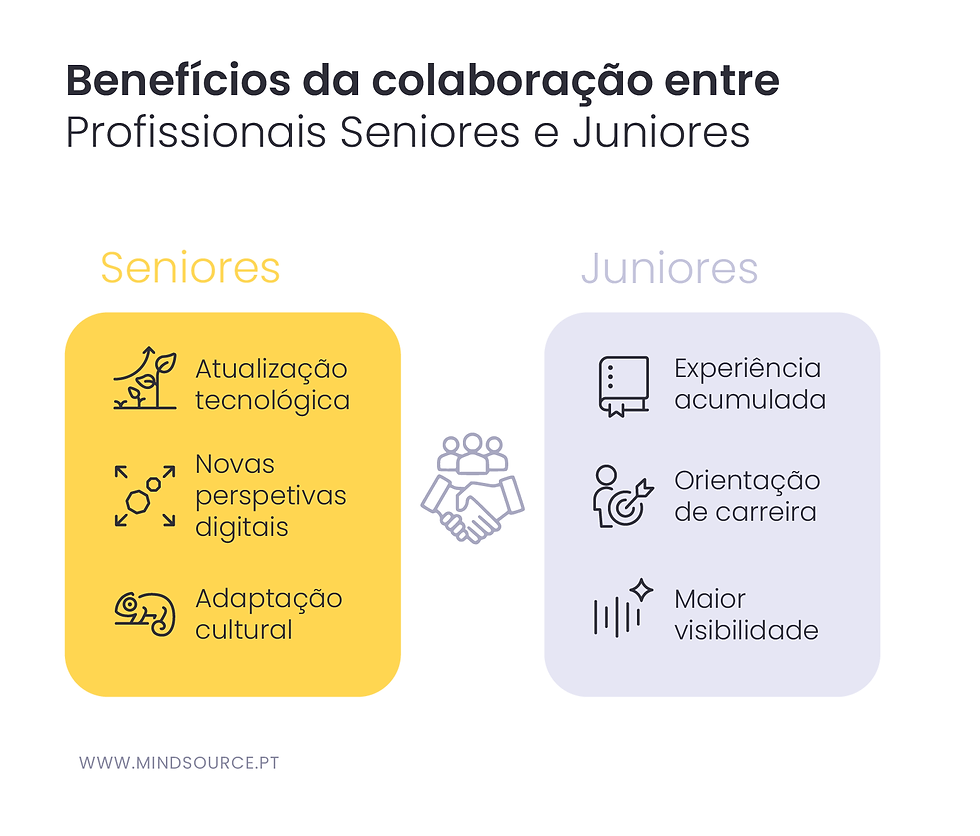
Updating in emerging technologies: juniors are often closer to the latest languages, frameworks, and agile methodologies.
New digital perspectives: younger generations bring a fresh vision of digital trends and user behaviours.
Cultural adaptation: constant exchange helps senior professionals better understand the expectations of new generations at work.
What do early-career talents gain from reverse mentoring?
Access to accumulated experience: they learn from strategic decisions and complex contexts that only experience can provide.
Career and leadership guidance: seniors can support progression planning and skills development.
Greater internal visibility: by engaging with senior profiles, juniors increase their networking and exposure within the organisation.
Benefits for IT Companies
It’s not only the professionals who benefit from this interaction; companies also gain advantages:
A culture of sharing and collaboration
Increased innovation, thanks to the combination of experience and new ideas
Higher talent retention, as both seniors and juniors feel valued and heard

How to implement reverse mentoring in practice
Structured Reverse Mentoring Programme:
1. Define objectives:
It is important to define clear goals for both sides.
Examples: Accelerate digital transformation, promote generational diversity, develop digital skills, foster innovation.
Define what you want to achieve and which results you will measure. How is programme success defined? For example: new initiatives implemented, improved skills, satisfaction feedback.
2. Selection process:
Create a matching process between mentors (young professionals) with relevant skills and mentees (leaders/seniors) interested in learning those skills, based on:
Objectives
Profiles
Complementarity of knowledge
Availability
This matching process can use an initial questionnaire or 15-minute interviews.
3. Initial training
Before the kick-off, it is essential to train both participants so they have the right tools. Workshops on “How to Give Feedback” and Communication / Active Listening can be useful to maximise the benefits of the process.
4. Define meeting plan
Recommended duration (how many months the programme will last)
Meeting frequency (monthly, for example)
Format (online, in-person or hybrid)
Suggested duration
5. Support tools
Meeting agenda templates
Discussion question guides
Suggested monthly topics (e.g., digital tools, market trends, youth culture, experimentation)
Participant handbook
Space for sharing resources
Learning log form
Follow-up materials (checklists, guides, short videos)
6. Continuous monitoring
Checkpoint meetings with HR
Simple monthly report
Possibility to adjust pairs if necessary
7. Evaluation and communication of results
At the end of the process, results are evaluated. This reinforces the programme’s value and encourages future editions.
Collect feedback from both sides
Measure impact against the defined objectives
Gather success stories and share internally
Reverse mentoring is more than a trend, it is a strategy for companies that want to grow sustainably. By enabling senior and junior professionals to learn from each other, stronger, more innovative teams are created, ready for the challenges of digital transformation.


